
Barnette’s Conjecture for Humans, Part 2
In Part 1 we covered the conjecture, the “harlequin” nomenclature, and a portion of the OpenAI proof. In this post we’ll introduce a few more terms and further flesh out the proof. Here’s the flow chart from earlier, this time highlighting the part that this post focuses on:
I’ll explain the strange vocabulary shortly. Most of it is pre-existing terminology although I adopted “quiver” in a bespoke way.
So, in this post we seek to prove:
For every prime harlequin
This is the same as Barnette’s conjecture as harlequins from part 1 but constrained to prime harlequins. If we combine it with Composite harlequins reduce, we will have proven the conjecture.
The strategy for proving the above theorem is to show that the following three lemmas are true (we’ll explain what these statements mean along the way):
- Prime harlequins always have Tutte pairs.
- Some Tutte pair has an acyclic pink quiver.
- An acyclic pink quiver makes two trees.
It turns out that the second one is, by far, the hardest to prove, so I’ve postponed it to Part 3.
1. Tutte states, pairs, and quivers
Vocabulary time!
The three corners of the root triangle are the root vertices, and the other black triangles are the inner black triangles.
A Tutte state of a harlequin puts a dot in each inner black triangle, in the corner at one of its vertices, so that every vertex gets exactly one dot, except for the root vertices.
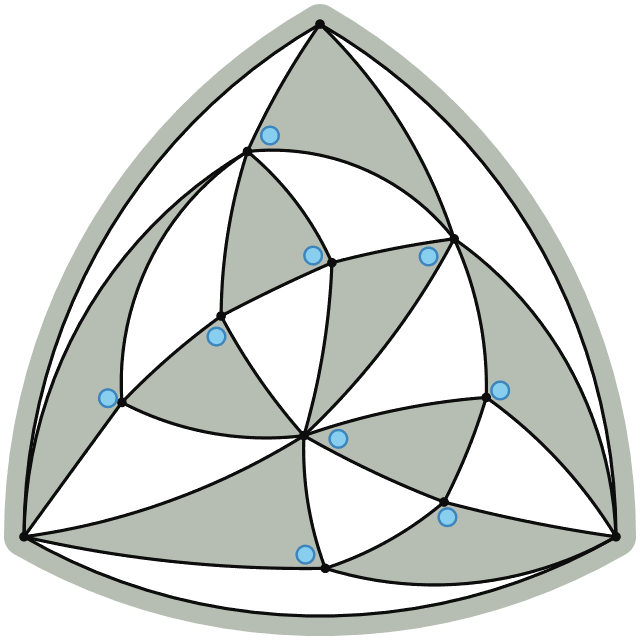
When I learned about Tutte states, I immediately wondered if it’s always possible to formulate them, or if certain harlequins don’t permit them. To answer this, you first need to ask if the # of inner black triangles is the same as the # of inner vertices.
Let’s say that a harlequin has
- Every harlequin with
black triangles has total vertices. - Every harlequin with
black triangles has inner vertices.
The second counting lemma is a hint that harlequins always have Tutte states. In fact, every harlequin is guaranteed to have a Tutte state, which is a bit less obvious. Tutte proved it in 1948 by matching states with spanning arborescences.
A spanning arborescence of a directed graph is a tree that reaches every vertex, with all of its arrows pointing away from one vertex, its root. So every other vertex has exactly one arrow coming in. (We won’t be using arborescences in the proof.)
Next let’s discuss an interesting mathematical object that can arise from a Tutte state:
A quiver of a Tutte state is a directed graph with one arrow leaving each dot, along one of the two edges that enclose the dot. Each dot picks its side on its own, so a state with
Every inner vertex has exactly one arrow leaving it. So if you start anywhere and follow the arrows, you either reach a root vertex or go around in an infinite loop. Here are three quivers of a single Tutte state:
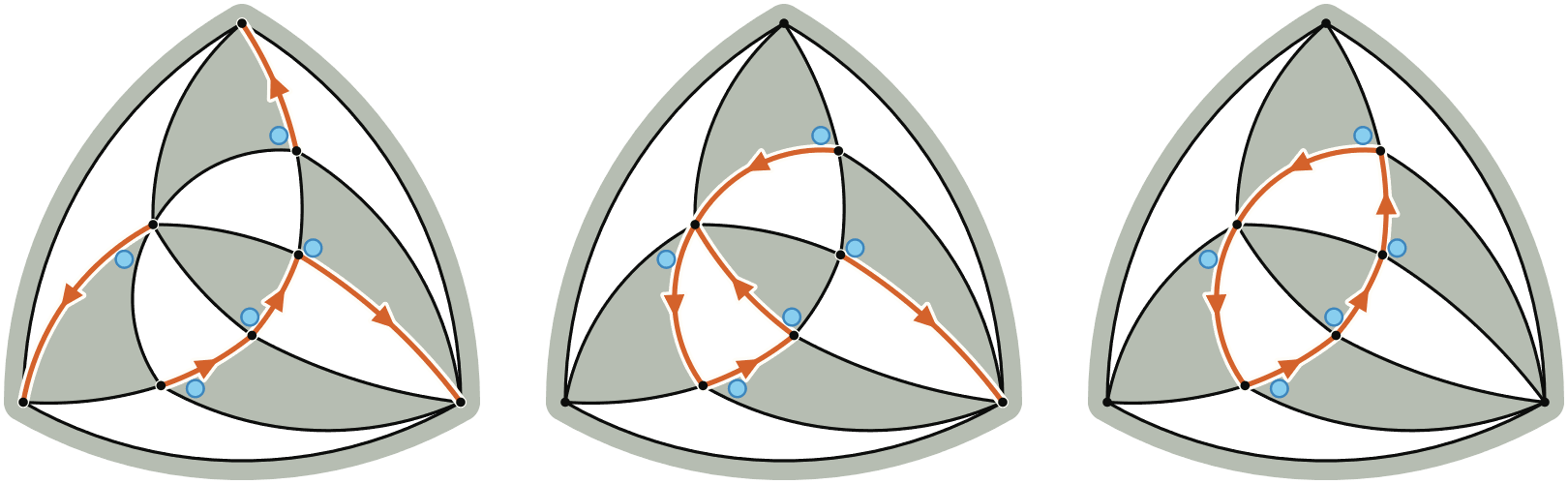
The quiver on the left is acyclic: from every vertex, the arrows lead to a root. The middle one is mixed: some vertices lead to a root, and others lead to an infinite loop. The one on the right is a cycle cover: every inner vertex is on a cycle.
A Tutte pair is two Tutte states of the same harlequin, one blue and one pink, that put their dots in different corners of every inner black triangle.
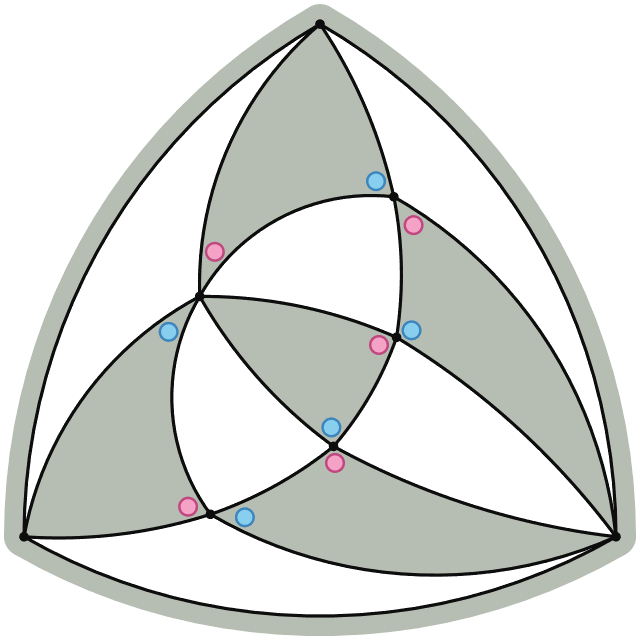
Pairing states this way is somewhat obscure although some people tried it before the OpenAI proof. For example, the rooted cycle covers of David Eppstein and Elena Mumford are Tutte pairs in disguise. We’ll talk more about Tutte pairs later in the post, so let’s move on with the vocabulary:
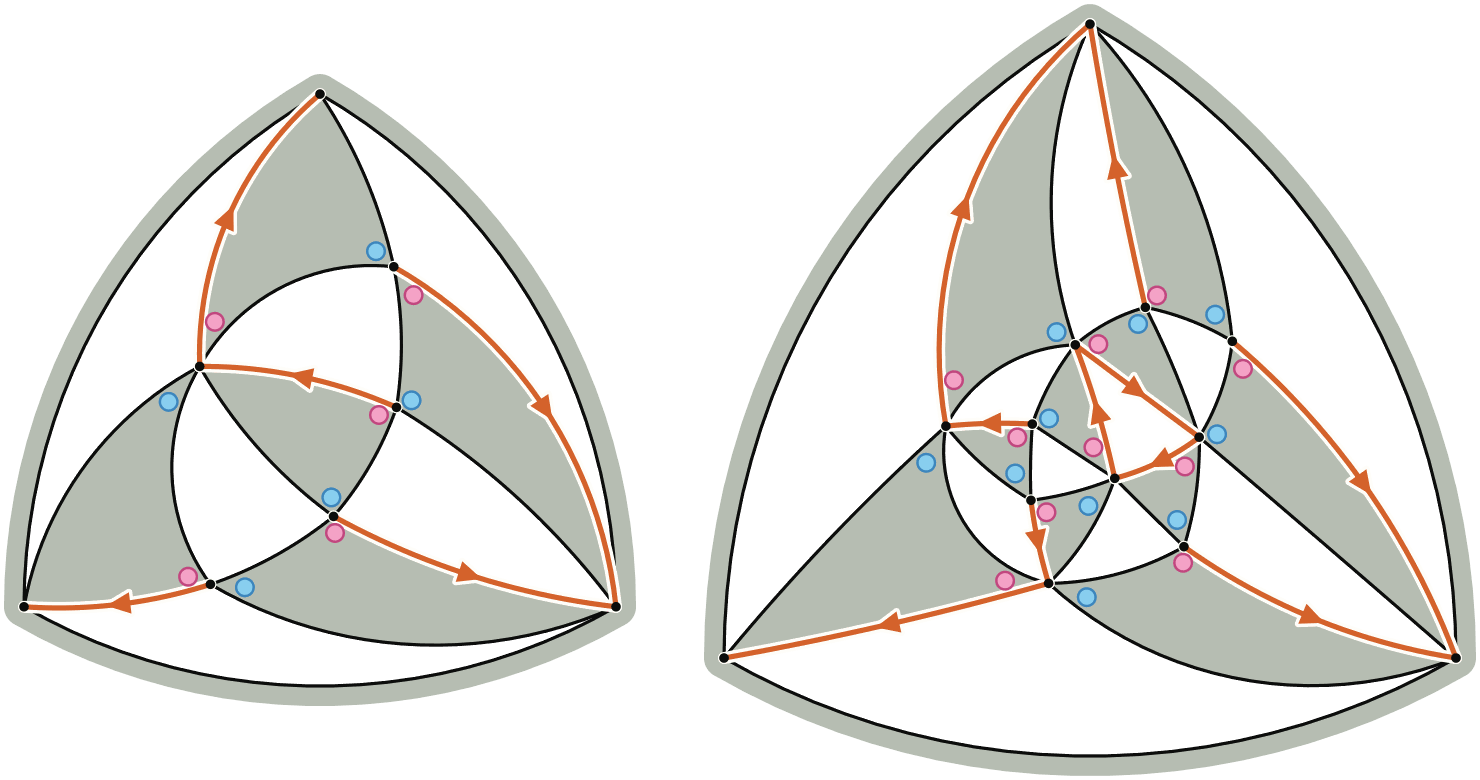
In a Tutte pair, the blue quiver has an arrow from each blue dot to the pink dot in the same triangle. The pink quiver has an arrow from each pink dot to the empty corner of its triangle.
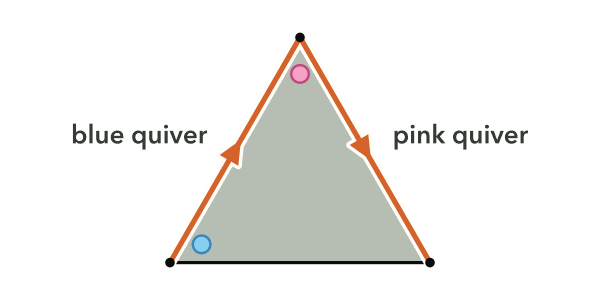
The blue quiver is one of the blue state’s many quivers: the one that points at the pink dots. Here are the blue quivers of two Tutte pairs:
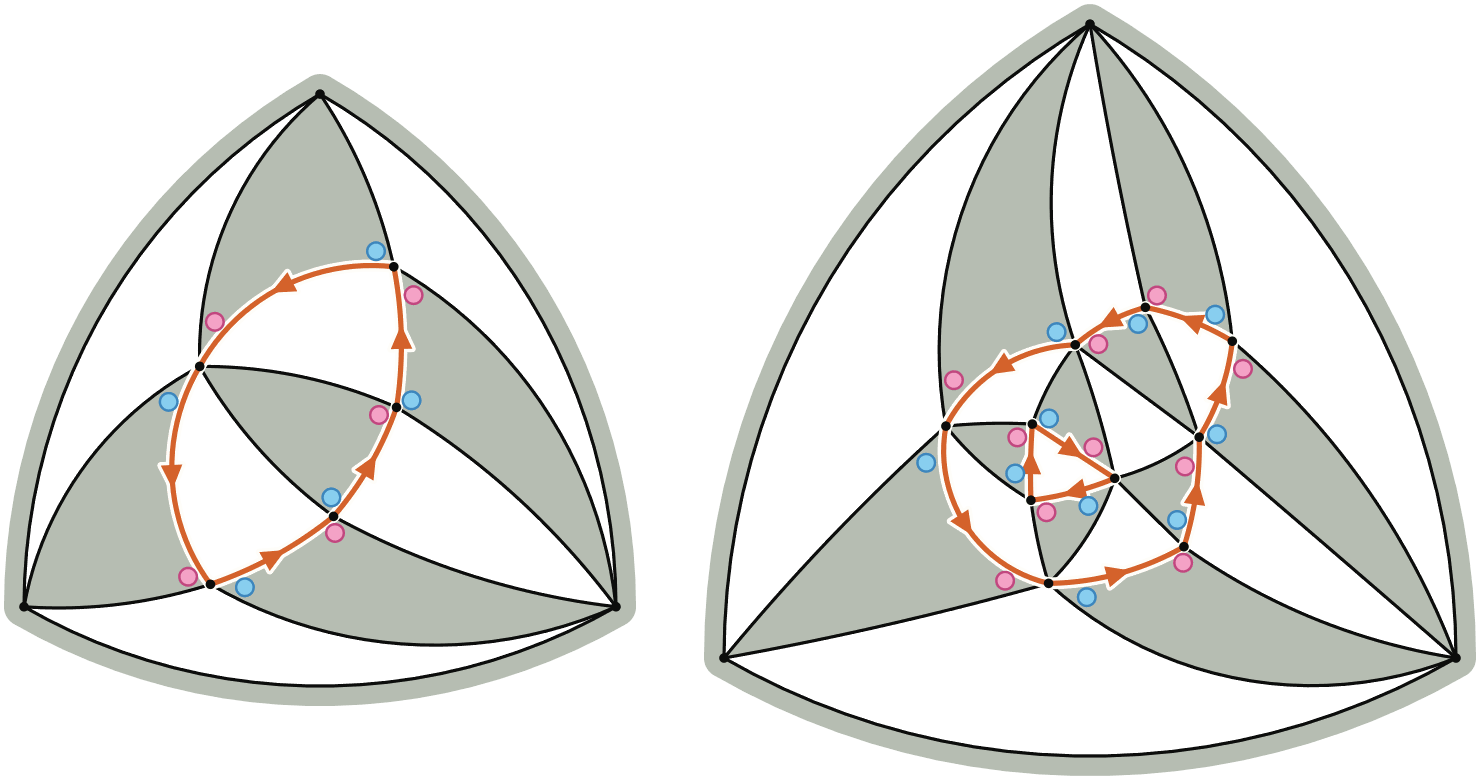
All blue quivers are cycle covers. Pink quivers are a bit messier. Here are the pink quivers of the same two pairs. The one on the left is acyclic; the one on the right is not. The distinction between acyclic and non-acyclic quivers is quite important, as we’ll see later.
2. Prime harlequins always have Tutte pairs
For every prime harlequin
Eppstein and Mumford found an interesting relationship between Barnette graphs and “orthogonal polyhedra”:

Orthogonal means built out of right angles: every edge runs along one of three directions, like in a pile of boxes. Every Barnette graph is the graph of an orthogonal polyhedron. The left figure is the dual of the harlequin whose Tutte pair we saw earlier, rebuilt as an L-shaped block.
When the harlequin is prime, there’s more: the polyhedron can be built to fit into the corner of a room, against the floor and two walls, so that looking into the corner along the diagonal, you see every face but the three against the floor and walls. Eppstein and Mumford call these corner polyhedra, and any black vertex can be the hidden one.
The figure on the right is not a corner polyhedron, even though its harlequin is prime: the underside of its overhang, for one, is out of sight. However, the claim is that a corner polyhedron can be built from any Barnette graph whose harlequin is prime.
When looking at a corner polyhedron along the diagonal in an isometric projection, take a look at the 2D projection of all edges attached to a vertex. Sometimes they form a sharp corner (less than 90°). It turns out that each visible face has exactly two sharp corners, and they’re always black.
Eppstein and Mumford wanted to know which Barnette graphs can be built as corner polyhedra, and the answer is all about sharp corners. Sharp corners are Tutte pairs in disguise. The block’s corners are the harlequin’s triangles, and its faces are the harlequin’s vertices. The hidden vertex in the back is the root triangle, and the three hidden faces are the root vertices.
Lemma 29 of their paper says this:
For every 4-connected Eulerian triangulation
, and every choice of a root triangle , there is a cycle cover of rooted at .
That’s actually equivalent to our “Prime harlequins always have Tutte pairs” statement, but in their language!
The vertices in a Eulerian triangulation all have an even number of adjacent edges, which is exactly when its triangles can be colored like a harlequin’s. In a triangulation, any three vertices that cut it apart make a separating triangle, so 4-connected is equivalent to “prime”.
A cycle cover rooted at
In the name of brevity I won’t repeat their proof here; let’s move on to the next lemma of interest.
3. An acyclic pink quiver makes two trees
If you glance back at the flow chart, another statement we need to prove is “Make two trees”, or, more precisely:
For every harlequin
The proof takes four steps, each with a numbered drawing. You might recognize drawing 1; it’s the earlier example of an acyclic pink quiver.
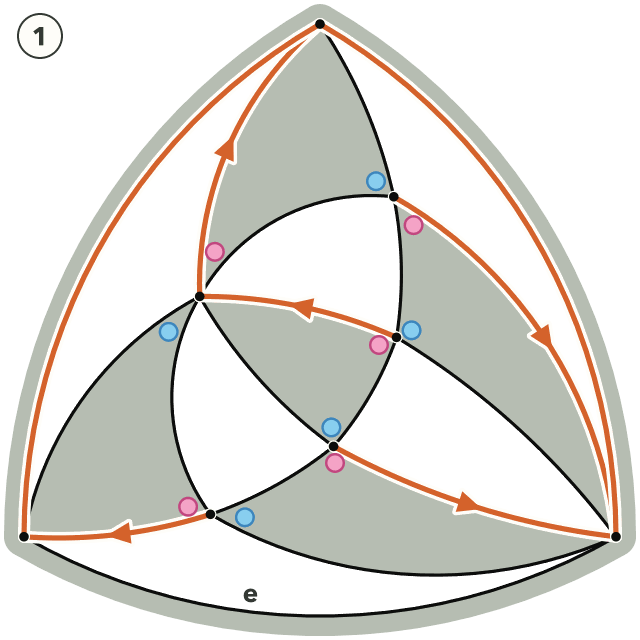
Say that
In the drawing, we’ve joined together the three trees using the two sides of the root triangle other than
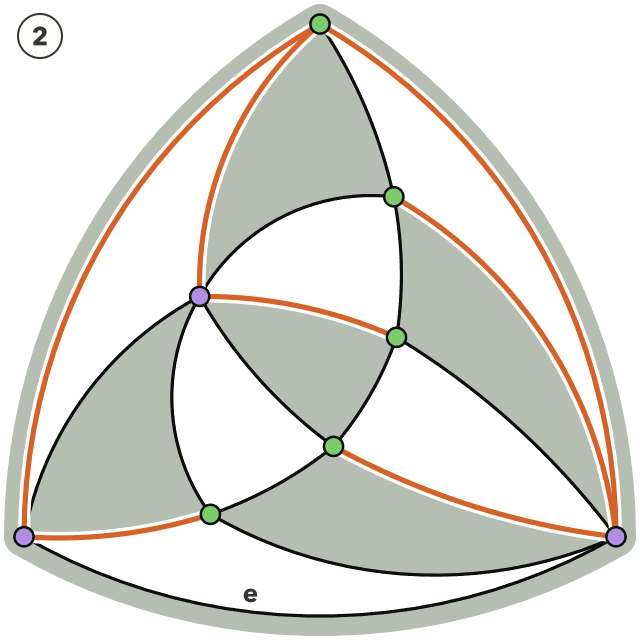
Now color the vertices. Color the corner of the root triangle across from
Call an edge matching if its two ends have the same color. There are two possible color configurations for any triangle: all three sides are matching, or exactly one is. Either its corners are all one color, or two of them share a color and the third doesn’t.
Each inner black triangle has a side in the tree, which isn’t matching, so it has exactly one matching side. So does the root triangle: its matching side is
Every edge borders exactly one white triangle too, so the
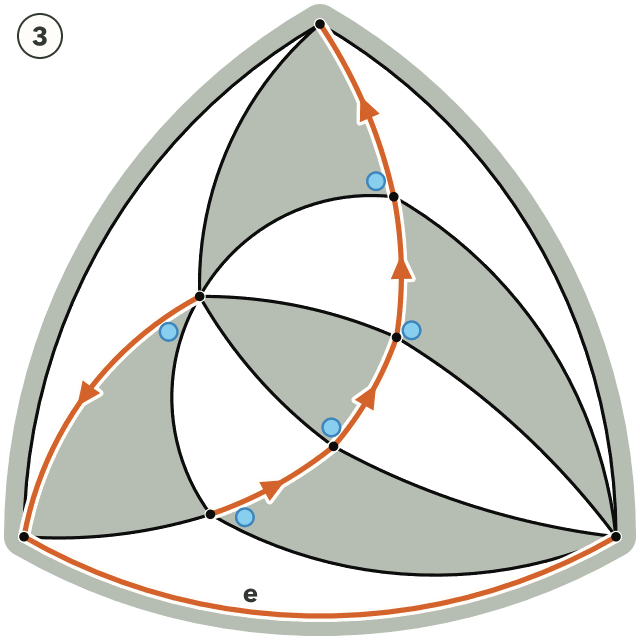
In an inner black triangle, the side in the tree is its pink arrow, which runs from the pink dot to the empty corner. So the matching side is one of the other two, which both touch the blue dot. Point it away from the dot, as in drawing 3. Every vertex but the roots has one blue dot, so it gets its own arrow, along a matching edge, and no two vertices share one.
Let’s prove that matching edges cannot form cycles. Suppose the matching edges had a cycle. A cycle cuts the harlequin into an inside and an outside. Pick a cycle with as few triangles inside as possible. Its vertices are all one color, say green. Look at a triangle just inside one of its edges. Its third corner is purple, since every triangle has exactly one matching side. So that purple vertex is strictly inside the cycle.
Now follow the matching arrows from that vertex. They stay purple, so they can’t touch the green boundary, and no edge crosses it. Every vertex strictly inside has an arrow leaving it, since all three roots are outside or on the boundary. Sooner or later the walk repeats a vertex. That gives us a purple cycle strictly inside the green one, with fewer triangles inside. So the matching edges can’t have a cycle after all.
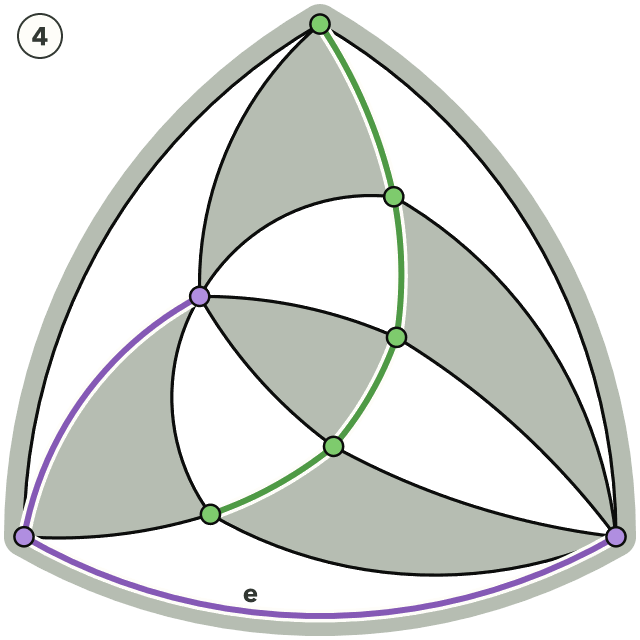
With no cycle, the matching edges make a bunch of trees, each with one fewer edge than vertices. So the
Every edge between two vertices of the same color is matching, so it’s in one of the trees. So each color induces its tree, and
Drawing 2 already had the coloring we were after, so it might seem like steps 3 & 4 were needless, but the subtlety was in showing that each color induces a tree.
We’ve now accomplished the stated goal of this section: we’ve shown that, given an acyclic pink quiver and a side
4. Conclusion
At this point we’re left with only one unproven lemma:
For every harlequin
Chain the three lemmas together and you get the prime harlequins theorem: the edge
5. References
- The OpenAI proof: Paired states and Hamiltonian cycles in cubic bipartite planar graphs, 2026.
- W. T. Tutte, The dissection of equilateral triangles into equilateral triangles, Proceedings of the Cambridge Philosophical Society, 1948. The tree trinity theorem, and the count of Tutte states.
- David Eppstein and Elena Mumford, Steinitz theorems for orthogonal polyhedra, 2009, and in the Journal of Computational Geometry, 2014. Corner polyhedra, and Lemma 29, the rooted cycle covers that make Tutte pairs.